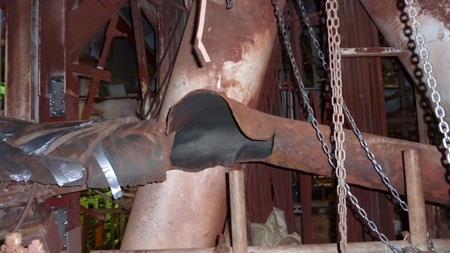
Oil giant Marathon has been handed a £1.16m fine over safety failures that caused more than two tonnes of methane gas to escape from a corroded pipe on one of its North Sea platforms.
Failed Gas Pipe
Aberdeen Sheriff Court was told that an eight-inch diameter high pressure pipe in Module 14 of the platform sustained a “catastrophic” rupture because of corrosion under insulation (CUI), allowing the high-pressure methane gas to be released almost instantaneously. The corrosion was caused by salt water from one of the rig’s fire extinguishing systems that used seawater, Energy Voice reported.
The force of the high-pressure blast caused significant and widespread damage. None of the 100 workers on board the platform were in Module 14 when the rupture happened, with many of them in the accommodation block ahead of their Boxing Day meal. No one was injured.
The Health and Safety Executive (HSE) said Marathon Oil would have “identified the risk [of CUI] and prevented the hazard from materialising” had it properly inspected the pipework. These safety failings, it said, exposed workers on board the Brae Alpha platform to an “unacceptable risk of serious personal injury or death” from a fire or explosion.
Marathon’s defence solicitor told the court several improvements have been implemented on the rig to prevent a similar incident re-occurring, including an effective hydrocarbon pipework inspection and maintenance regime. The solicitor said that after the Energy Institute published updated guidance on managing corrosion in oil and gas production and processing in 2008, Marathon was faced with an “immediate backlog” of inspections to complete and so introduced a system to rank risks by priority.
Marathon accepted there was a failure in ranking the risk posed by the corroded pipe as “low” but noted it had gas detectors and auto-shutdown technology in place to reduce the risk of fire.
After the hearing HSE inspector Ahmedur Rezwan said: “Corrosion under insulation is a well-known risk and this incident should not have occurred. “During any normal period of operations, personnel could easily have been working in or transiting through Module 14 and they would almost certainly have been killed or sustained serious injury. The timing of the incident and fact that the gas did not ignite was fortuitous.”
Most of us familiar with some variation of the proverb “he who knows and knows he knows” may recognise at least one person in each of the categories of knowledge described: the expert, the student, the sleepyhead, the fool. Arguably, the most interesting of those types is: “He who knows not and knows he knows not – he is asleep, wake him.” These are people who don’t know enough about a particular subject but, crucially, they admit their ignorance, which makes them ripe for educating.
In terms of being a proficient leader in safety and health, the first step is to be open about what you do not know and admit you find it difficult. The next steps involve acquiring the knowledge to understand what good safety and health looks like and how to achieve it. To be a good leader you have to be receptive to education and accepting of the responsibility that comes with your role.
It was with the aim of helping its leadership teams assess their sites and functions against the overall organisational culture that Swiss flavourings and fragrances manufacturer Givaudan put education at the heart of its EHS Excellence model and strategy. Although EHS stands for environment, health and safety, at Givaudan it also encapsulates the company’s mission to ensure everyone goes home every day.
“That’s how we measure effectiveness,” says John Pares, the company’s head of EHS field organisation for Givaudan worldwide. “Our mission is to empower people to safeguard the environment and their own and others’ health and safety.” Pares has been instrumental in devising and implementing Givaudan’s EHS Excellence model and strategy, which was developed after an exercise by the company to determine its “cultural DNA”. This is a combination of behaviours and traits that fall within three themes: inspiring, challenging, with heart and soul. The aim of EHS Excellence is to highlight and capitalise on the critical elements of Givaudan’s DNA.
Pares says: “We published the strategy, which runs to 2020, in 2016 and it has three pillars: trust – around internal and external compliance; risk – understanding, assessing and managing it; and culture – embedding ‘everyone home safe every day’ into our culture by educating and empowering managers, and engaging employees.”
DNA analysis
Believing that you cannot deliver the first two of these without the third, Pares took on culture as his responsibility – “without even knowing what we needed”. Working with an external consultant – who was chosen because she asked “how do you know what you need?” instead of simply offering an off-the-shelf solution – Pares and his team built their own model. He says: “We had already been through the Givaudan DNA exercise, so we couldn’t go to the executive committee and present it with yet another culture. Instead, we looked at what was in the DNA that would help us drive the EHS culture.”
They began by determining which of Givaudan’s 64 production sites worldwide had the best safety performance – “based not just on figures,” Pares says, “but on attitudes and perceptions” – the idea being to bring all sites up to their level. Two in the fragrances’ division – one in Mexico and one at Ashford, in Kent, UK – were identified. Extensive interviews were carried out across all functions to find out what employees felt made their sites so special.
Pares says: “From these interviews, we pulled out common themes, but the question then was how to group them. This is where the model comes in. We developed a set of statements and then tested them, via a survey, on five other sites of various sizes across both divisions – fragrances and flavourings. Based on those, we made some tweaks and eventually settled on the model we’ve got.”
The EHS Excellence model comprises 12 elements: reporting; communication and information; teamwork; systems/processes/procedures; risk assessment; goals and key performance indicators; context; culture and values; mindset and behaviour; leadership; people; and training and development.
“Leadership is the key one,” Pares says. “When we first put together the strategy and model, it wasn’t a very positive session with the executive committee. There was a lot of ignorance of topics, so I quickly realised I needed to do a lot more work on and with leadership. In 2018, we set objectives for every site and turned this into a workshop in order to have face-to-face contact with leadership teams.”
Givaudan’s warehouse in Makó, Hungary
The workshop approach is a key part of the model and to raising the visibility and impact of the EHS culture at Givaudan. The half-day, hands-on events are aimed at each site’s leadership teams, who are expected to carry out a self-assessment and develop actions bespoke to their location.
The workshops are led by one of the company’s eight regional EHS managers: “It’s our culture, so it would have been wrong to use an external consultant or trainer,” Pares says. “The EHS managers’ role was to facilitate – not to tell the sites what their culture is but to let them decide where the gaps are and how to plug them using their particular strengths.”
A pre-workshop questionnaire covering measurable features such as near-miss reports and lost-time injuries (LTIs) gave Pares and his team a set of answers to take into the workshops. He says: “We plotted the range from the questionnaires against the perceptions that were voiced in the workshops. This enabled us to get into discussions as to why there are big ranges in some instances – for example, a different culture between operations and the office environment.
John Pares and John Vernieri, head of operations for the fragrances division, presenting the IOSH training certificate to Ernesto del Callejo, one of Givaudan’s trainers in Mexico“The really rich conversations were had around the gaps between the numbers and the perception ‘why do we think we are great at this, but the numbers tell us something different?’. This was a way of getting the leadership team to realise where we are now and what we can do about it.”
Other principles of the workshops include focusing on the positive things happening on sites, not just on whatever needs fixing, and promoting contrast and conflict by discussing differences and asking “why?”. The product of each workshop is a set of actions that the leadership teams commit to deliver.
All operational Givaudan sites have now done the workshops, except the most recent acquisitions. Pares says: “We are Givaudan’s largest global flavourings production facility in Makó, Hungary, which opened in 2013 and whose construction was overseen by John Paresnow starting on the non-operational sites because we don’t want people to think EHS is just about ops. As we say, it’s everyone home safe at the end of the day, not just some people.”
The safety and health remit at Givaudan stretches way past senior leaders. However, the focus on the shopfloor in terms of training and education has resulted in some management levels being overlooked. Pares says: “We’ve always put in most effort at shopfloor level, then site level, and we kind of missed the top level. By the time we got there, we didn’t need to convince them but simply educate them on what they needed to do.”
One particular group identified as in need of attention was first-line managers and supervisors. “These are people who are pressurised from above and below, so we realised we really needed to invest in them,” Pares says. “We put ‘empowering line managers’ into our EHS strategy, and this was picked up by HR, which is now focusing on this level of management as well.”
Management focus
In fact, this group is now a key target for Givaudan’s Leadership Senses programmes. A new pilot programme, called Discover, has been developed specifically for first-line managers and supervisors. As well as focusing on leadership qualities, coaching ability and giving feedback, it includes an interactive, practical section on safety and quality. Pares provided case studies for the programme so that the participants can “apply the leadership skills they are learning to a health and safety topic”.
The company’s safety and health professionals have their own EHS academies. These stem from the EHS strategy and the desire to create one professional EHS function. Pares says: “We host an academy every year for 30 people – different participants every year – to develop their skills and teach them how to apply their EHS knowledge.” The most recent academy, in 2018, focused on improving business partnering and embedding EHS culture in employees’ day-to-day work.
EHS professionals are supported across the organisation by a network of facilitators, for whom a training programme was developed last year to enhance and support local ownership of EHS matters. These developed from the EHS ambassadors programme at Ashford, says Pares: “The facilitators are part of the culture pillar of the EHS strategy. It’s a global programme that was piloted in 2017-18 and first rolled out in the Europe and Middle East region. All sites in this region will be completed at the end of this year. Rollout has also begun in Latin America and the United States.”
Facilitators are those who have a strong interest in EHS but are not EHS professionals. They can be in any role – for example, fire stewards, first aiders and safety representatives – and join the extended EHS team, where their overall responsibility is to develop and maintain a strong EHS culture by engaging employees throughout their site.
An external consultant helped Givaudan to develop the facilitator training programme, which IOSH accredited. “This is really important,” Pares points out, “as it means those who complete the training get a certificate. While EHS professionals have lots of certificates and qualifications, it’s really important to our facilitators to have that external recognition.”
Once certified, they have the knowledge and skills to organise and deliver 15-minute training sessions to co-workers on specific EHS topics. So far, 17 trainers hold the certificate, as well as more than a hundred facilitators. The aim is to have at least one facilitator for every 50 employees, covering all work environments: factories, labs and offices.
The diversity of work environments and countries in which Givaudan operates can hinder implementation of global programmes. Pares, who is British, finds these differences particularly interesting. “Take the UK and Switzerland, for example. British people are good at setting and following rules, and things are generally done in a structured, systematic way. The downside of that is that when something goes wrong it’s often seen as someone else’s fault; there’s a lack of responsibility. In Switzerland, the approach is more, ‘We tell you what the risks are and you decide’. On the plus side, this encourages responsibility but, on the minus side, it means people can choose to do things the wrong, unsafe way.”
He feels the best Givaudan sites in terms of safety and health are in India. “There is a particular flavourings site there that has gone ten years without an LTI and, during the recent construction of a new factory, there wasn’t a single lost-time accident. Typically, when they have problems, they don’t ask for money as the first solution – they say, ‘We will use what we have, our people, to improve safety’. They just get on and do stuff. It’s all about leadership and teamwork – exactly what I am looking for in my model.”
The next steps for Pares and the EHS model include rolling out the workshops for leaders to non-operational sites and the EHS academies and facilitator programmes across all sites. Givaudan is constantly making acquisitions – there have been nine in the past five years alone – so Pares will also need to focus on bringing them on board.
He says: “Givaudan prioritises safety, quality, service, cost – in that order. If a decision has to be made, we don’t compromise on safety. But we don’t say ‘safety is our highest priority’; it simply underlines everything we do. If we can’t run the business safely, we can’t run the business.”
As that famous old proverb also advises: he who knows and knows he knows, he is a wise man – heed him.
A farmer has been ordered to pay a £30,000 court bill after a friend who was working for him died after he fell through a cowshed sky light.
East Wales Magistrates Court
Defendant Robert Latham, aged 64, of Knolton Farm at Overton, near Wrexham, admitted a health and safety charge following the tragedy in July last year.
David Alan Rees, 56, of Ruabon, was clearing the roof of moss when he fell, North East Wales Magistrates’ Court at Mold was told. Mr Craig Morris, prosecuting for The Health and Safety Executive, said a ladder had been used to go up onto the roof to clear moss from the guttering.
But there was no safe system of work in place and he fell. It was not known precisely when he fell but he was found on the floor of the cowshed under the sky light. An ambulance was called, he was taken to hospital, but died of his injuries.
Mr Morris said that with the moss on the roof it was very difficult to identify where the sky lights were. Mr Rees was a friend who worked for Latham on a casual basis.
Guttering
There were no measures in place to prevent him falling off the roof or through the sky light, Mr Morris added. He said there was a bucket with moss on the floor which indicated Mr Rees had been up earlier to clear moss from the leaking guttering.
Mr Morris added there was not the slightest hint Latham had any disregard for safety matters on the farm. Defending barrister Mr James Buchanan said it was a genuinely tragic case.
“This is not a case where an individual has instructed another to do a task he was not prepared to do himself,” he said. “He thought he had a safe system of work in place. He didn’t.”
District Judge Gwyn Jones imposed a fine of £26,000 with costs of £3,922 and a £170 surcharge. He accepted an offer of £500 a month. The judge said the case concerned was a tragic accident in which a much-loved friend and casual worker Mr Rees lost his life.
He had worked at the farm for many years and also kept his collection of Minis which he was doing up in a building.
Women’s Institute members have been banned from baking cakes for ill hospice patients in Leicester, due to health and safety rules.
The Leicestershire and Rutland WI has been told has been told by Leicester hospice charity, LOROS, that they can’t accept cakes from the organisation unless the council carries out an environmental health inspection and approves their kitchen.
The comments came after Leicester City Council food safety experts inspected LOROS’ kitchen in February and told staff about the strict regulations.
Despite the hospice boasting a five-star food hygiene rating – the highest score available – the council insisted the cakes must be baked in a registered kitchen.
“To comply with current food safety regulations, the cake maker that supplies the snack bar must be registered with the council as a food establishment. This process is simple, free of charge and registration cannot be refused.” – LEICESTER CITY COUNCIL STATEMENT
A Liverpool recycling company must pay £120,000 after an employee was fatally crushed by a falling stack of plastic bales.
Paul Andrews was working in the immediate vicinity of the stack at Centriforce Products’ Derby Road site when the free-standing column toppled over on 24 May 2017. The middle and top bales, which weighed more than 500 kg, fell on Andrews, crushing him. The scene of the collapse was not discovered until nearly an hour later when efforts to revive the employee failed.
Liverpool Crown Court was told that, after the waste plastic bales had been delivered to the site, they were stacked as free-standing columns in a yard. During the morning, a forklift truck driver noticed one of the columns consisting of bales, stacked three high, had partially collapsed obstructing his path. He then used the truck to straighten and stabilise the stack before continuing on his way. Some hours later, Andrews began work around the stacks.
The Health and Safety Executive (HSE) found Centriforce Products had failed to store the plastic bales securely in such a way as to prevent the risk of collapse. It also did not carry out a suitable risk assessment, which would have identified the risks of working near unstable stacks.
Centriforce Products, of Errington Works, Derby Road, Bootle, pleaded guilty to breaching s 2(1) of the Health and Safety at Work Act. It must also pay £10,541 in costs.
SPA has introduced a new course specifically made for those employees and contractors who work within the vehicle mis-fuelling industry. Vehicle mis-fuelling is where a driver may put petrol into their diesel vehicle or vice versa. There are approximately 150,000 mis-fuels every year within the UK.
Currently those involved in the activity could hold a current SPA Petrol Retail card to work on a Forecourt. Over 60% of mis-fuel activity happens away from the forecourt environment and so the existing petrol retail course doesn’t quite meet the requirements of the sector. SPA have been working alongside a working group – Roadside Fuel Recovery Standards (RFRS) http://rfrs.org.uk/ that has been set up to look at the requirements of those working within the mis-fuelling industry. The RFRS group is made up from mobile fuel remediation companies, equipment manufacturers and mixed fuel disposal organisations who have all brought their expertise into the new course. The group is looking to include the activity of mis-fuelling into a national standard for the breakdown & recovery industry which is known as PAS43. Part of the PAS43 standard will include safety training for those working within the industry.
Due to the specialised nature of this industry the new course will be 3 days in duration
Day 1: SPA Core Day
Day 2: Mis-fuellers Course which includes some elements of the existing petrol retail course
Day 3: Breakdown & Recovery standards and ADR / Hazardous Goods awareness
New people coming into the industry may now consider the new 3 day course to prove safety competency as a vehicle mis-fueller. Those who already hold an SPA petrol retail passport can now take a refresher course which is made from days 2&3.
Due to the very specific requirements of the industry SPA require training providers who have a good understanding of the industry including breakdown, recovery and fuel handling environments. There are 2 external SPA training providers at launch;
City Fuel Services 0161 641 2918
NE Risk 07772 033523
The new SPA Vehicle Mis-fuellers course is launched on 1st September 2016.
SPA will also be at the RFRS stand at the Tow Show – 6-7th September which is held at the Telford International Centre.
Further details of the vehicle mis-fueller passport scheme can be found here
Safety Pass Alliance have joined forces with the Petrol Retailers Association (PRA) to offer a comprehensive online training programme for all forecourt operators and their employees.
The e-learning package, developed in association with SPA and PRA’s technical team which gives employees a greater understanding of the level of risk while working on a forecourt and how to ensure the safety of themselves and the public.
The training package comprises three modules:
Module 1: An induction for all new employees covering safe site operation, legal responsibilities, flammable products, hazard zones, forecourt ignition sources, site security, forecourt incidents, spills & leaks, fire and emergencies
Module 2: This covers daily operations it includes security, forecourt equipment, incident reporting, mis-fuelling, weather, and managing visitors and contractors
Module 3: Covering the safe unloading of tankers, this module include safe storage, preparing for a tanker, ullage, preparing documentation, unloading fuel, driver-assisted, actions by the driver, vapour recovery, emergencies and documentation
The training, which offers a consistent approach for all staff, even on multi-site estates, takes 2.5 hours for each employee to complete on a PC, laptop or tablet and can be easily monitored by managers. Each module has a printable certificate on successful completion
“Working with the SPA, the PRA’s technical officers have drawn on their many decades of experience and consulted with members of the Technical Committee to ensure that this new e-learning package captures everything that is necessary to enable employers to be confident that they have provided their staff with sufficient training to carry out their roles in a safe and competent manner,” says the PRA’s technical director Phil Monger.
“The SPA and PRA have worked within and beyond the guidelines for Petroleum Forecourt Operators Training issued by the Petrol Retailers National Steering Group, and are confident that it fits exactly what is required in the complex field of petrol forecourt safety and retailing compliance.”
The course will be open to both PRA and non PRA Members who can purchase the learning from SPA or directly through Paypal on the SPA e learning website.
Pricing per user (all 3 modules);
Non PRA Members – £54.95 incl VAT
PRA Members – £44.95 incl VAT
Dealer Groups can contact SPA directly for term & conditions sales@safetypassports.co.uk 01926 817450
Safety Pass Alliance is working with UKWA and are proposing to encourage temporary workers to carry a Safety Passport card that proves they have been appropriately trained and met required standards for the industry. UKWA are keen to hear your thoughts – would you support a Safety Passport?www.ukwa.org.uk/files/2914/5639/8438/NEWSrack_feb_2016.pdf
SPA are pleased to announce their new course – SPA Core Construction Day.
This course is aimed at those individuals who wish to apply for a green CSCS labourers card. Since October 2014, anyone wishing to take the CSCS online test must first take a one day level 1 course – Health & Safety in a Construction Environment. The new SPA course is equivalent to a level 1 QCF course and recognised by CSCS.
Safety Pass Alliance (SPA) achieves another milestone by passing the 20,000 mark for Contractors now using the SPA Petrol Retail Safety Passport scheme. The Southam based organisation of one of the Country’s leading leading providers of safety passport programmes and work within a wide variety of industries within the UK and abroad.
SPA Managing Director Ray Gibbs said
“This is a fantastic achievement and fully endorses the value of running safety passport programmes. Since SPA formed the partnership with the UK Petrol Industry Association (UKPIA) the scheme has brought about a higher understanding of health and safety issues amongst forecourt contractors. This has been achieved by working closely with the industry to create a course that’s relevant and up to date for those who need to undertake the training. By understanding the high degree of risk involved in working in this area, the SPA Petrol Retail Passport scheme has provided training solution that help safeguard the activities of Contractors, Staff and the Public when working on filling station forecourts”.