Author Archives: admin

Construction companies fined after accident at Jersey building site

TWO construction companies have been fined a combined total of £20,000 after an employee was knocked off an inadequately set-up platform by a 27kg concrete-pouring hose, causing him to fall four metres to the floor.

Deputy Bailiff Tim Le Cocq

Enda Armstrong, from Moy Construction Ltd, and Cris Fosse, from Fosse Construction Ltd, both appeared before the Royal Court on Friday after pleading guilty to multiple counts of breaching health-and-safety laws.

Crown Advocate Conrad Yates, prosecuting, told the court how on 10 July 2017 Anthony Kelly, an employee of Moy Construction, had been working at a site in St Brelade under the control of Fosse Construction ahead of a planned concrete pour when the incident occurred.

The court heard how ‘formwork’ boards, which acted as a mould for a concrete wall, had been erected and Mr Kelly was standing on a four-metre scaffold platform above them.

As a hose, attached to a 32-metre arm from a concrete pump truck, was moved over the mould, it inadvertently became caught in three of the arm’s securing clips – used when the truck is being driven.

Soon after, the hose detached from the clips, causing four metres of hose to come loose and swing into Mr Kelly – knocking him four metres off the platform and onto a set concrete floor. He suffered head and body injuries.

Advocate Yates said that no protective toe-boards or mid-rails had been installed on the platform and that a safe-work method statement had been completed inadequately. He called for a fine of £30,000 for Fosse Construction and £20,000 for Moy Construction.

But Advocate Simon Young, defending Fosse Construction, said that the £30,000 fine sought by the prosecution was ‘egregious’, adding that the scaffolding had not been erected over a public highway or above where people were working.

And he said that although his client might not have put sufficient protective measures in place, the accident had ultimately been caused by the loose hose swinging into Mr Kelly.

Meanwhile, Advocate Debbie Corbel, defending Moy Construction, said that the health-and-safety infractions had not been an attempt to cut corners or maximise profits and that her client had been ‘candid’ in admitting personal responsibility for the breaches.

She added that since the incident, a third-party company had been employed to compose safe-work method statements for each job. Announcing the court’s sentence, Deputy Bailiff Tim Le Cocq said that although there had been no flagrant or deliberate breach of health-and-safety laws, both firms had failed to mitigate the risks of working at height.

‘In our judgment, both defendants fell below the appropriate standards but not far below,’ he said.

‘It is clear that both companies have good safety records and are caring and conscientious employers.

‘We must look at the reality and in our view we may treat this as an exceptional case in sentencing and we therefore believe that the fine called for by the Crown is too high.’

Fosse Construction Ltd was fined £12,000 and Moy Construction Limited was fined £8,000.

Jurats Anthony Olsen and Elizabeth Dulake were also sitting.

Jersey Evening Post
Investigation launched after worker ‘crushed’ at North Wales recycling plant

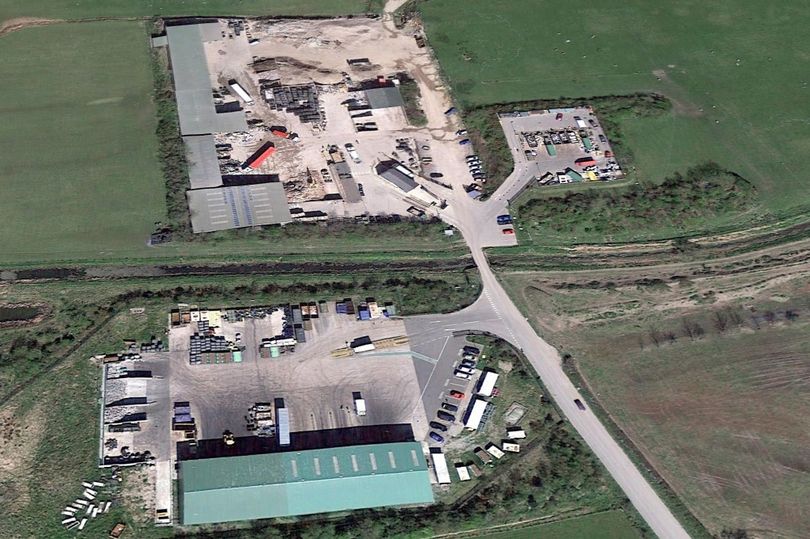
The man was flown to Stoke after the incident at the Thorncliffe (Abergele) site.

The Health and Safety Executive is investigating after a worker was injured at a recycling plant. The man was flown to hospital in Stoke by air ambulance after the incident at the Thorncliffe site on Rhuddlan Road in Abergele just after 11.30am on Thursday morning.

It is understood the member of staff suffered serious crush injuries. His condition is currently unknown.

A HSE spokesperson said: “HSE is aware of the incident and making initial enquiries.”

Thorncliffe has been asked to comment.

North Wales Live

Scaffolder’s signature forged on safety briefing register before 12 metre plunge

A scaffolder who was signed in at a safety briefing despite not being present later fell 12 m from a scaffolding structure at a Port Talbot steelworks.

Stephen Kift sustained multiple life-changing injuries at Tata Steel’s plant in South Wales in 2014 and he continues to suffer from poor health. 

 Kift’s employer, Rowecord Total Access, has been fined £9,600 over the incident and ordered to pay £32,544 in costs. Swansea Crown Court was told that Kift was part of a team disassembling a 21 m-high scaffolding structure on 18 January 2014, following maintenance work on an angle tower at the site’s Morfa coke ovens. The workers removed a plate in the scaffolding, so they could clear debris below, and erected a temporary edge protection system around the gap, Wales Online reported.  

 However, Kift, whose safety line was not attached at the time, fell through the hole. He struck a steel girder – a support beam used in construction – before landing on another girder.  He now uses crutches for walking, is in constant pain and cannot sleep for longer than four hours at a time.  Rowecord pleaded guilty to breaching health and safety regulations. Tata Steel was cleared of safety offences.  A previous trial of both companies was prematurely stopped last November after it was revealed one of Kift’s colleagues had forged his signature on a register, claiming he had received a safety briefing that he had not attended.  

 According to BBC News, Judge Peter Heywood said: “It is clear that a briefing took place, but it is clear that Mr Kift was not present and someone falsely signed on his behalf.” Anna Vigars, QC, for the Health and Safety Executive (HSE), said the safety briefing for scaffold workers “should have been more robust” and the fact someone was able to pretend they had been there “speaks to a failure to ensure everything was done as it should have been”, Wales Online reported.  

An investigation found that Rowecord also had failed to properly plan and supervise the work at height. Simon Morgan, defending Rowecord, said this had been an isolated incident; the company took safety and health legislation very seriously and had a good track record, he said. The company lost its contract with Tata Steel following the fall.

IOSH Magazine

Company fined £150k after driver’s death

A County Londonderry quarrying company has been fined £150,000 for breaches in health and safety following the death of one of its employees over four years ago.

Magherafelt company FP McCann Ltd, which employs 600 people, had been accused of the corporate manslaughter of dumper truck driver Victor Nicholl and of failing to ensure there was a suitable restraining system at its Knockloughrim premises on March 13, 2015.

However the charges were “left on the books” and not proceeded with, after the company, with a turnover of over £200m, admitted two breaches in failing to ensure the health, safety and welfare of employees, and failing to ensure the quarry and its equipment were maintained.

Antrim Crown Court Judge Geoffrey Miller QC, sitting in Belfast, said while it was accepted the company breaches did not amount to systemic failure, “the fact a death occurred, notwithstanding that this was not directly linked or attributed to those failings, amounts to a very serious aggravating feature of this case”.

Mr Nicholl was crushed beneath the wheels of the spare, and older, Aveling Barford dumper truck he had been driving while his own was in for repair. He had left his cab, for some unknown reason, and was killed when the truck rolled forward.

Judge Miller said while he had to assess the culpability of the company and its directors in their failings and the amount of fines to impose, “nevertheless at the centre of this case is a man whose life was tragically cut short by the terrible events of that day”.

However, he added that “nothing said or done today can ever restore the deceased to life or provide recompense for that loss felt by those dearest to him at his passing”.

In the wake of Mr Nicholl’s death, an investigation by the Heath and Safety Executive (HSE NI), and an examination of the Aveling Barford truck highlighted a number of faults. They included low brake efficiencies, no parking brake, no emergency steering and no working seatbelt.

A safety berm in the stockpile area was also found to be below the recommended height of 1.5m, although it was sufficient to stop the truck on this occasion.

Judge Miller said: “There can be no doubt that there is a high duty placed upon those such as the defendant company.”

He added: “In such circumstances any defects can create a serious risk, and in that regard this defendant clearly fell short on this occasion.”

However, in his conclusions he said that while the breaches were serious and not confined to a single omission or failure of procedure, “there is no direct link between the breaches and the death of Mr Nicholl”.

Judge Miller said in the circumstances he would impose fines of £75,000 for each of the two breaches, and would allow the company up to three months to pay the total £150,000.

In a statement issued afterwards, HSE NI principal inspector Anne Boylan said: “The vehicle that Mr Nicholl was driving on the day of the incident had not been maintained in a safe condition and was not fit for use in a hazardous environment such as a quarry.

“Employers must ensure that work equipment, including work vehicles, undergo regular planned maintenance.

“Failure to do so may result in unsafe vehicles, leading to potentially serious or even fatal accidents.

“Robust systems must be in place to check that maintenance schedules are adhered to and vehicles are in a safe condition at all times,” she said.

Belfast Telegraph

Company sentenced after worker suffers life changing injuries in fall

A company, two directors and a self-employed contractor have been sentenced and fined after an electrician fell two storeys through an unprotected stairwell.

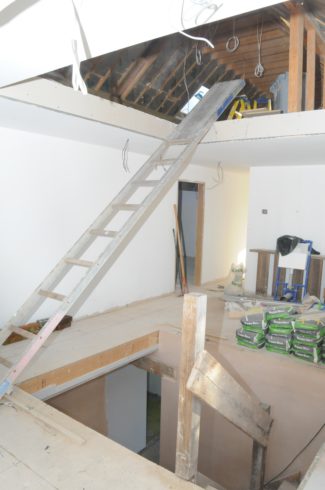
Manchester and Salford Magistrates Court heard how, on 1 December 2016, Mr T Quirk was carrying out electrical work at Mile House, Main Road, Worleston, Nantwich, Cheshire, CW5 6DH. This property was owned and was being refurbished by self-employed contractor Mr Steven Dixon.  Mr Quirk, whilst exiting the loft, fell from a damaged Youngman Board spanning the stairwell, landing on the concrete floor below and suffering multiple fractures, a bleed on the brain and facial nerve damage.

An investigation by the Health and Safety Executive (HSE) found that two directors of the company, Mr Karl Grice and Mr Sean Mullan, were fully aware, along with Mr Dixon, that the damaged board was being used as a makeshift ladder and had used it themselves.  They were also aware of the unprotected edges of the stairwell, but had not carried out risk assessments, identified which control measures were needed, or implemented suitable safety measures to protect workers on site.

Green Generation Renewable Services Ltd of Knowsley Industrial Park, Liverpool, pleaded guilty to breaching Regulation 15 (2) of the Construction (Design and Management) Regulations 2015 and was fined £20,000 and ordered to pay costs of £2,548.28

Mr Karl Grice of Highmarsh Crescent, Newton-Le-Willows, pleaded guilty to breaching Regulation 15 (2) of the Construction (Design and Management) Regulations 2015, by virtue of Section 37 of the Health and Safety at Work etc. Act 1974 and was sentenced to 16 weeks in prison (suspended for 18 months) and fined £1,000 and ordered to pay costs of £2,000.

Mr Steven Paul Dixon of Warmingham Grange Lane, Sandbach, pleaded guilty to breaching Section 3 (2) of the Health and Safety at Work etc. Act 1974 and was sentenced to 16 weeks in prison (suspended for 18 months) and fined £1,000 and ordered to pay costs of £2,000.

Mr Sean Mullan of Argyle Road, Garston, Liverpool, pleaded guilty to breaching Regulation 15 (2) of the Construction (Design and Management) Regulations 2015, by virtue of Section 37 of the Health and Safety at Work etc. Act 1974 and was fined £1,500 and ordered to pay costs of £2,000.

After the hearing, HSE Inspector Deborah Walker said: “This incident could have so easily have been prevented. Falls from height remain one of the most common causes of work-related injuries and the risks associated with working at height are well known. Those in control of work have a responsibility to devise safe methods of working and to provide the necessary safety measures.”

HSE

Incident alert – Return roller nip guard on conveyor falls 4m and hits contractor

A contractor was lucky to escape serious head injuries whilst maintenance work was being carried out on a conveyor belt system, a metal return roller guard fell 4m and hit his hard hat.


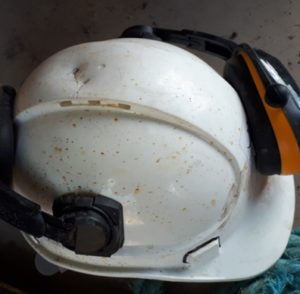
Hard hat with dent along back near centre

The contractor was standing under the incline conveyor belt system as he pulled the old conveyor belt through the system. During this operation an original return roller nip guard was dislodged. Investigation showed that it was designed so that it hung over the roller shaft and was only held in place by the belt and gravity.

The guard weighing circa 8kg fell 4m and hit the contractor on the centre of his hard hat. Fortunately, the contractor suffered only neck and muscle strain and was able to continue working after a short period.

This design may exist on conveyor systems on other sites.

LEARNING POINTS / ACTIONS TAKEN

  • Check to see if this type of system is present on your site
  • If they are on site, amend risk assessments / safe systems of work to include the need to check how roller nip guards, rollers and scrapers are secured
  • Ensure all return roller nip guards, rollers and scrapers are securely fixed before any conveyor belt replacement work commences
  • Any person carrying out a task where objects or items above them could fall should wear a hard hat, not a bump hat.
  • Exclusion zones should be set up in any area where equipment is being worked on overhead

The Global Mineral Products Health & Safety Hub

Hand injury on disassembly line costs Recycling Company £133,000

Recycling company Viridor Waste Management has been sentenced after an employee’s finger was partially amputated on a fridge dismantling line.


The incident happened at the company’s waste electrical and electronic equipment plant in St Helens, Merseyside, on 8 October 2017.

 Sefton Magistrates’ Court was told that Alan Tabern reported there was a defect on the machine when its hydraulic cutters stopped working, but the procedure to make the equipment safe was not subsequently followed. The cutters were left close to where Tabern was operating, the Health and Safety Executive (HSE) said. As he moved them out of the way, they amputated the top of his right index finger and severed another.

The HSE’s investigation found that although defects with the cutters were common, they were not always reported and the procedure for lock-off and isolation was not permanently enforced.  

Viridor pleaded guilty to breaching s 2(1) of the Health and Safety at Work. It has been fined £133,000 and ordered to pay costs of £4,205. HSE inspector Catherine Lyon said: “The life changing injuries caused by this accident could have been avoided if the procedure for the safe lock-off and isolation of equipment had been followed. Employers should ensure their safety procedures remain effective by monitoring their use and checking that they are being fully implemented.”  

A spokesperson for Viridor told letsrecycle.com: “Prior to this [accident], Viridor had site-specific risk assessments and safe operating procedures with training for staff at the St Helens site. In addition, in 2008, the company retrofitted additional safety measures and introduced task-specific risk assessments and procedures along with further training on safe behaviours. “Viridor has also implemented a comprehensive strategy for health and safety called ‘HomeSafe’. This is designed to raise standards, prevent harm and create a culture of safety targeting 4,600 people across the company.  

“The district judge at Sefton Magistrates’ Court acknowledged the company’s genuine regret regarding the accident, and recognised HomeSafe as one of the many considerable steps taken by Viridor to raise health and safety standards.”

IOSH Magazine

Investigation – Good Medicine

We can be fairly confident in saying that virtually nothing can be achieved without investigation. We investigate from our first steps and continue through the rest of our lives. In our professional life, investigation is part of planning, design, risk assessment and almost everything else. It is therefore unfortunate when companies think that investigation is just a health and safety methodology only to be used when things go wrong.


David K Ramsay, Group Managing Director, Kelvin TOP-SET

“We expect our doctors, opticians, dentists and even our car repair garage technicians to have diagnostic skills, so why wouldn’t we expect this of all staff within their area of expertise?

“Looking at this from a professional perspective, hopefully it can be seen that investigation is a powerful business tool, and that the skills acquired on an incident investigation course can have a much wider application.

“Over at least thirty years, we have developed a practical and easy to use methodology based on real experience from problems in small and medium-sized companies to some of the biggest failures and incidents imaginable, in everywhere from the offshore oil industry, to nuclear and aerospace industries. Therefore, we do understand that when incidents occur, particularly when safety has been compromised, there is a need to investigate to prevent recurrence. However, a professional investigation methodology enables the organisation to gain information from every part of the company and hence have the knowledge to make positive changes that will improve both performance and safety.

“Senior managers in all companies talk about their commitment to safety, but this has to be more than fine words because the alternatives can be unthinkable, including:

  • Loss of life, injury
  • Financial loss, depressed share value
  • Loss of company reputation, negative press or
  • Prosecution of directors.

“However, these are negative outcomes – ‘Bad Medicine’. By looking at investigation as ‘Good Medicine’, companies can identify what they are good at; what they can do even better. One of our clients trained 150 people to be investigators. Clearly, they didn’t need this many trained investigators, maybe just five or six, but what it did do was raise their knowledge level about the causes of incidents and failures, and hence operational safety levels. This approach can be related to and be part of other safety initiatives such Risk Assessment, BowTie HAZID, HAZOP, Front-End Engineering and Six Sigma.

“There is a huge misunderstanding about Root Causes across all industries. So often we are asked to train people only in Root Cause Analysis, and while we can do this, and even have a specific e-learning programme on it, the point is frequently missed. There has to first be a definition of the problem, then an investigation of the facts, before proceeding to analysis. Surprisingly frequently, we come across the real problem which is not thinking about the problem first. In one extreme case, an organisation that we worked for had lost £500 million (yes you read that correctly, half a billion sterling) because they hadn’t defined the problem or investigated what they really needed to. It was a total failure of ‘Front-End Thinking’.

“I appreciate that the audience for this article is probably made up of safety professionals, but the approach is the same whatever our discipline; it is about gaining information that can help us to improve our processes and hence safety. As one director of a company in an extremely high-risk industry told me, where they’d had fatalities in the past, ‘You can never take your foot off the gas, because if you do, it all very quickly starts to go wrong’.”

Causes of incidents

“It may seem an oversimplification but virtually all incidents are caused by two things:

  • Change and
  • Decisions that people make (or don’t make).

“Many years ago, I coined the term ‘Organisational Rust’. Real rust, for want of a better term, is the slow degradation of mild steel over time. So it is in all of our organisations; small things, even tiny changes, often unnoticed, are going on all the time and, sometimes, building up to a point where they all come together and there is a major incident. Take time to look over the reports of any major incident in the public domain and you’ll find that there were a whole series of ‘minor’ failures that contributed to the final disaster.

“You may see this as controversial but try it for yourself. If things are going along fine, nothing happens, but if it does happen, there has to have been something different, there has to have been change. Then when we dig deeply, we find that, usually, well-intentioned people are involved in an error, maybe of design, bypassing a control, or failing to foresee consequences of an action. This is by no means finger pointing, it’s just a reality; people have to be at the heart of everything. So, hopefully, we can see that investigation can be good medicine, helping people to avoid having incidents. We talk a lot about preventing recurrence, but how much better is it if we prevent things going wrong in the first place?

“Taking the ‘Good Medicine’ approach is akin to having a healthy lifestyle and maybe also regular health screening. This is good management; being in touch with what is really going on, talking to all staff, and keeping people informed.

“Looking over decades of incident investigations, there is a surprising commonality in the failures and causes that we have seen, and they almost all have a major element of communications at their heart. From our own personal lives, we know that poor communication causes so many problems, and we are all guilty of this. So, why would it be any different at work where things are usually more complex?

“Effective risk assessments that cover all of the possibilities require creative thinking, teamwork and excellent communications and professional investigation.

“The question is not why would you train people as investigators, but rather why wouldn’t you?”

SHP Online – 23.05.18

Granite worktop company fined after failing to carry out safety checks

Mold Magistrates’ Court heard how Grantech Limited was not having regular statutory examinations carried out on lifting equipment and also failed to carry out repairs when defects had been found.

A granite worktop manufacturer has been fined after failing to ensure that lifting equipment was examined and maintained to ensure it was safe to use.

Following an inspection on 18 June 2018 by the Health and Safety Executive (HSE) at the site in Buckley, it was discovered that the examinations were not carried out at the required six monthly intervals and when they were carried out the same faults were reported, as the company were not taking action to effect the repairs.

Grantech Limited of Spencer’s Industrial Estate, Buckley have pleaded guilty to breaching Regulation 5 (1) of the Provision and Use of Work Equipment Regulations 1998 and Regulation 9 (3) of the Lifting Operations and Lifting Equipment Regulations 1998. The company has been fined £30,000 and ordered to pay costs of £4906.

Speaking after the case HSE inspector Mhairi Duffy said “This prosecution could so easily have been avoided by simply carrying out correct control measures and safe working practices. Companies should be aware that HSE will not hesitate to take appropriate enforcement action against those who fall below the required standards”.